

How to Collect Rent From Companies Like Starbucks, Chick-fil-A, and 7-Eleven Without the Landlord HeadachesDiscover how investment grade net lease property works, and who it’s for.
Dear Fellow Investor (especially if you’re tired of tenants, toilets and turnover),
If you want rent checks you can actually forecast, paid by some of the best known companies in America, a property net leased to an investment grade corporate tenant may be one of the best fits you’ll find.
If you own rentals, you know the math. Insurance, property taxes, repairs and turnover come out of your cash flow before you see a dime, and the “passive” part of passive income disappears into your phone.
Now picture the first of the month: a rent deposit from a company you shop at every week, and nothing on your to-do list.
REITs, pension funds and institutions have owned properties like these for decades. The door is open to you too: individual investors can buy them directly.
Doctors, CPAs, business owners after a sale, landlords trading out of apartments through a 1031 exchange, retirees who want income they don’t have to manage: it fits a lot of people. With the right lease, the tenant pays the rent plus the taxes, insurance and most maintenance, and the management work largely goes away.
You keep your time. You own the building, not a slice of someone else’s fund. Funds and syndications ask you to wire your money, pay their fees and trust the quarterly report. Direct ownership asks you to read one lease. And you know exactly who pays your rent.
It isn’t right for everyone, and the rest of this page will help you decide if it’s right for you.
You Can Own the Same Asset the Big REITs and Funds Own
Without the Fund Fees
Here’s a trivia question most investors get wrong.
What company has declared a monthly dividend 675 months in a row, without missing one?
It isn’t a bank. It isn’t a tech company. It’s a landlord.
In 1969, Bill and Joan Clark bought a Taco Bell property in Northridge, California, directly from Taco Bell founder Glen Bell. They collected the rent and paid it out to their investors every month.
That company is Realty Income (NYSE: O), “The Monthly Dividend Company.” Today it owns more than 15,500 properties. The formula hasn’t changed much since that first Taco Bell: buy the real estate a strong business needs to operate, sign a long net lease and let the tenant cover the taxes, insurance and upkeep.
It isn’t alone. NNN REIT has raised its dividend 37 years in a row. Agree Realty and W. P. Carey are built on net leases too. And when GIC, one of Singapore’s sovereign wealth funds, wanted in, it didn’t buy a few shares. Together with Oak Street, it bought the whole company, STORE Capital, in a deal valued at about $15 billion including debt. When sovereign wealth funds write checks that size for these properties, pay attention.
Think of it as a bond wrapped in real estate: a stream of rent backed by a company’s credit, with a building underneath.
Here’s the part the REIT brochures leave out. Buy REIT shares and you own a slice of a company that owns buildings. You pay for its management and overhead, and the share price moves with the market every day, whether the tenants pay or not.
Own the building yourself and the math changes. You choose the tenant, the location and the lease. You claim the depreciation, which can shelter part of your rent. And you can use a 1031 exchange to defer tax when you sell and trade up. REIT shares can’t do that, because Section 1031 applies only to real property.
Realty Income started with one property. So can you.
Sources: Realty Income, Our Story, and dividend release, Sept. 8, 2026; NNN REIT dividend release, July 15, 2026; GIC and Oak Street STORE Capital closing release, Feb. 2023; IRS, “Like-kind exchanges now limited to real property”; IRC §§ 168 and 1031. General information, not tax or investment advice.
More Residential Investors Continue To
Transition to Investment Grade Commercial Properties
Remember that one lease? Here’s why it matters.
It’s 11:40 on a Sunday night. Your phone lights up. Unit 3B has water coming through the ceiling, and the tenant wants to know what you’re going to do about it. Tomorrow you’ll be calling the plumber, the insurance adjuster and maybe the tenant in 3C, whose ceiling is next.
If you own rentals, you don’t have to imagine that call. You’ve taken it. You may have done well with residential, and the returns aren’t the problem. The work is.
Apartments run on short leases, often 12 months. Every year you’re re-renting, repainting, re-screening and hoping the next tenant pays. Taxes, insurance and repairs move when they want to, and your budget is a guess until the year is over. Hire a property manager and you trade the phone calls for a cut of every rent check.
Now picture the same Sunday night with a different tenant.
A national company signs a net lease on your building. Under a true triple net lease, the tenant pays the rent and also the property taxes, insurance and maintenance. A broken pipe is their problem. There’s no Unit 3B. There’s no Sunday night call.
And the lease isn’t 12 months. In the first half of 2026, NNN REIT’s new acquisitions and investments carried a weighted average lease term of 18.2 years. One signature can replace years of turnover.
That’s why landlords trade up. Under Section 1031, investment real estate is generally like-kind to other investment real estate, and when the rules are met, no gain is recognized at the time of the exchange.
Be clear-eyed about it. Lease terms vary, and not every lease is true triple net. Some leave the roof and structure with the owner. Some are guaranteed by a franchisee, not the parent company. That’s exactly why you read the lease and check who signs it before you buy.
Do that, and your income stops being a guess. You know what the rent is, who pays it and for how long. That isn’t a better rental. It’s a different business.
Sources: U.S. Bureau of Labor Statistics, housing leases in the U.S. rental market (lease length, Jan. to June 2022); NNN REIT Q2 2026 results, Form 8-K Exhibit 99.1; Agree Realty Form 10-Q, June 30, 2026; IRC § 1031; IRS, Like-kind exchanges: real estate tax tips. General information, not tax or investment advice.
Why Investment Grade Income Property ?

INVESTMENT GRADE INCOME PROPERTIES PRODUCE PREDICTABLE, CONTRACTUAL INCOME
Rent is set by the lease, not by the market every day. An investment grade tenant carries an investment grade credit rating from S&P, Moody’s or Fitch. Leases often include scheduled rent increases, so read the escalation clause.

INVESTMENT GRADE PROPERTIES GIVE YOU OPTIONS
One asset class, many ways to use it, depending on your goals.
SUCH AS:
- Passive income paid on a set schedule
- Capital preservation backed by real property
- Appreciation and scheduled rent increases
- All cash or leveraged purchases
- 1031 exchange replacement property
- Depreciation, plus 100% bonus depreciation on qualifying shorter-life components, such as certain land improvements, often identified through a cost segregation study
- Step-up in basis for heirs under current law
- Multiple sectors: pharmacy, quick service restaurants, dollar stores, auto service, banks and medical
Bonus depreciation: IRC § 168(k), 100% for qualified property acquired and placed in service after Jan. 19, 2025 (IRS Notice 2026-11); the building itself is 39-year property and does not qualify (IRC § 168(c)). Step-up in basis: IRC § 1014. General information, not tax advice; talk to your tax advisor.

INVESTMENT GRADE REAL ESTATE = TANGIBLE ASSETS
Net lease investments are rooted in real property, buildings you can see, touch and drive by. You know the address, the tenant, the rent and the lease term before you buy. There’s no fund manager between you and the property, and under a true triple net lease the tenant handles the taxes, insurance and maintenance.
You get clarity, control and real collateral.
REGISTER HERE : GET THE INVESTMENT GRADE INCOME PROPERTY REPORTS
Investment Grade Corporate Credit Ratings Are Independently Verified
Before you ever buy a building leased to a company, someone has already graded that company.
In 1909, a financial publisher named John Moody started putting letter grades on railroad bonds, so investors could tell the sturdy ones from the shaky ones. Today Moody’s, S&P Global Ratings and Fitch are all registered with the SEC as rating agencies, and they grade many of the companies that sign net leases.
When a company is rated investment grade, a rating agency has given its opinion that the company’s capacity to meet its financial obligations is adequate or stronger. At the lower end of investment grade, that capacity is more exposed to a downturn, and a rating is an opinion, not a guarantee. Still, that grade can affect the cap rate, the financing you can get, the price you pay and, in the end, your return.
You wouldn’t hire someone without checking references. Don’t buy into a 15-year lease with a company you haven’t checked either.
Sources: Moody’s Investors Service company history; U.S. SEC, current NRSROs; S&P Global Ratings definitions; Moody’s rating scale. A credit rating is the agency’s opinion, not a guarantee of payment.
Independently Verified Investment Grade Credit Ratings By S&P, Moody's & Fitch Ratings
The Credit Ratings of Investment Grade Corporate Tenants are important because they can affect the Cap Rate, Financing, Pricing and ultimately the Rate of Return.
When you register for the White Paper: How to Earn Passive Income From Investment Grade Corporate Tenants, you will also receive our Investment Grade Credit Rating Report detailing scores on nearly 200 corporate tenants, investment grade and below.
Register and you’ll get our credit rating report covering nearly 200 corporate tenants, investment grade and below.
Here’s a mistake buyers make: they fall in love with the logo.
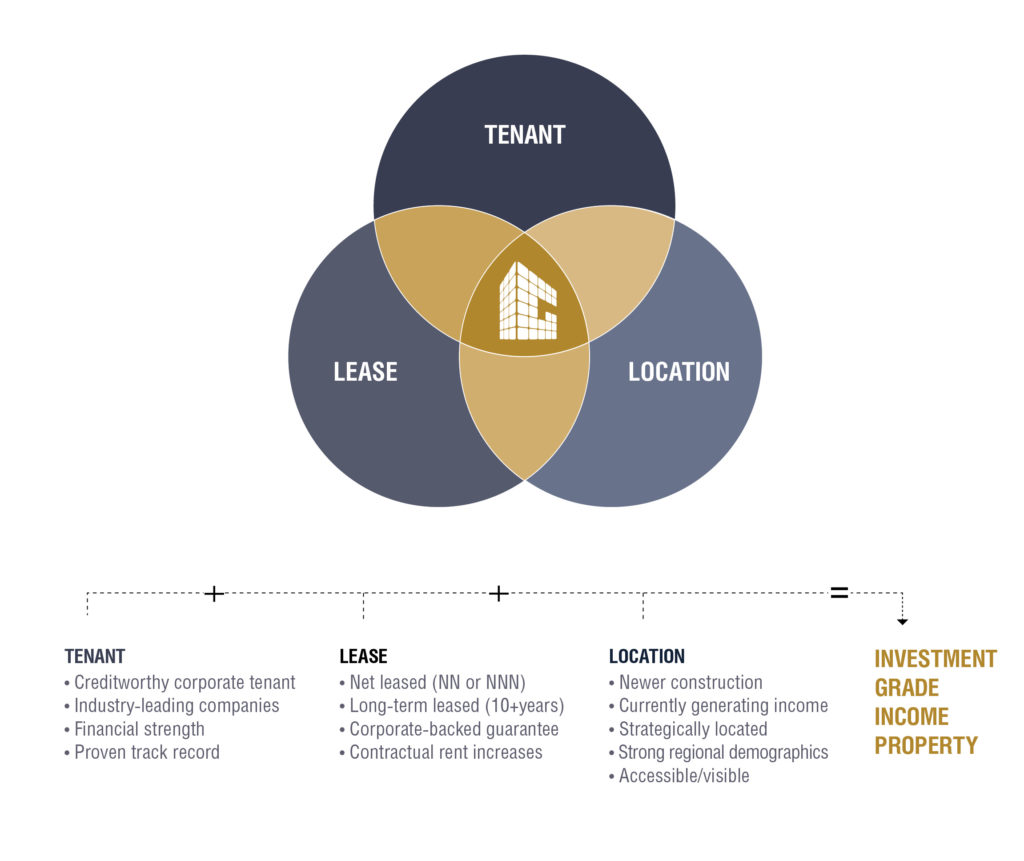
A great tenant is only one leg of the stool. Every net lease investment stands on three:
- Tenant: who pays the rent, how strong their credit is, and whether the parent company or a franchisee signs the guarantee.
- Lease: how long it runs, who pays for what, how often the rent goes up and what happens at renewal.
- Location: what the real estate is worth if the tenant ever leaves.
Kick out any leg and the stool tips. Credit pays the rent. Location protects you if the rent stops.
Find Out Who Are The Best Corporate Tenants








INVESTMENT GRADE TENANTS COME WITH SERIOUS ADVANTAGES
This isn’t just about picking good buildings. It’s about picking who pays you.
Think about the businesses people use no matter what the economy is doing: the places you stop for gas, groceries, prescriptions and lunch. These are the kinds of names you’ll find on net lease properties, across every essential category:
- Restaurants and coffee: Chipotle, McDonald’s, Chick-fil-A, Starbucks, Taco Bell, Wendy’s, Dutch Bros, Popeyes
- Pharmacy and healthcare: CVS, Walgreens, DaVita, Fresenius, Quest Diagnostics, Labcorp, HCA Healthcare, urgent care and dental groups
- Grocery: Kroger, Publix, Albertsons, Aldi, Whole Foods, Meijer, Hy-Vee
- Gas and convenience: 7-Eleven, Wawa, Sheetz, QuikTrip, Casey’s, Circle K, Love’s
- Dollar and discount: Dollar General, Dollar Tree, Five Below, Ollie’s, TJ Maxx
- Auto: AutoZone, O’Reilly, Advance Auto Parts, Valvoline, Firestone, Mister Car Wash
- Banks: Chase, Bank of America, Wells Fargo, PNC, Truist
- Big box, home and farm: Walmart, Target, Costco, Home Depot, Lowe’s, Tractor Supply
- Logistics and telecom: FedEx, UPS, Amazon, Verizon, T-Mobile
Here’s the part people don’t expect. Some of these companies are rated investment grade. Some are unrated. Some are rated below investment grade, and a few of the names you’d bet on may surprise you. Register, and the credit rating report shows you which is which.
And remember the lease. In the first half of 2026, NNN REIT’s new acquisitions and investments carried a weighted average lease term of 18.2 years. Compare that with re-renting an apartment every year.
Under a true triple net lease, the tenant pays the rent plus the property taxes, insurance and maintenance. Under an absolute net lease, the tenant can also take on the roof, the structure and capital repairs. Read the lease to see which one you’re buying.
What if a tenant closes the store? Some leases let a tenant “go dark” and keep paying rent. Whether the parent company stands behind that rent depends on who guarantees the lease, so check the guarantor before you buy.
When you sell, the remaining lease term and the tenant’s credit are what the next buyer is paying for. That’s where the value lives.
Tenant names are drawn from Investment Grade’s tenant ratings database (October 2026) as examples only; naming a company is not a statement about its credit rating. Lease term: NNN REIT Q2 2026 results, Form 8-K Exhibit 99.1.
You Will Learn How to Use 1031 Tax Deferred Exchanges as both an Exit Strategy and to Defer Capital Gains Tax
Here’s the tax problem successful investors run into. You finally sell, and a big piece of the gain goes to taxes before you can reinvest a dime.
Section 1031 changes that. Sell investment real estate, buy other investment real estate, and when the rules are met, no gain is recognized at the time of the exchange. Your equity keeps working.
But the clock is strict. You have 45 days from the sale to identify replacement property and 180 days to close, and the 180 days can be cut short by your tax return due date unless you extend. You can identify up to three properties of any value, or more if their total value stays within 200% of what you sold. Miss the rules and the exchange can fail.
That’s where we come in. We work alongside your qualified intermediary, the independent party that holds your sale proceeds under a written exchange agreement, and we line up net lease options before your clock starts. Your 45 days should be spent choosing, not searching.
What a 1031 exchange can do for you:
- Defer the tax. When the rules are met, gain isn’t recognized at the time of the exchange.
- Consolidate. The rules allow several properties to be sold in one exchange, so a handful of rentals can become one net lease property.
- Diversify. Move into a new property type or a new state. U.S. and foreign real estate aren’t like-kind to each other.
- Simplify. Trade the Sunday night calls for a net lease.
- Plan your estate. Under current law, heirs generally receive a stepped-up basis.
Now the newer tool. On July 4, 2025, P.L. 119-21, commonly called the One Big Beautiful Bill Act, became law. It made 100% bonus depreciation permanent for qualified property acquired and placed in service after January 19, 2025.
The building itself doesn’t qualify, because commercial buildings are 39-year property. But a cost segregation study can carve out shorter-life pieces, such as paving, sidewalks, landscaping and certain equipment, and qualifying property can be deducted in year one.
Not every tenant is equal here. A fuel station that meets the IRS tests for a retail motor fuels outlet is 15-year property, so the building itself may qualify. A ground lease gets nothing, because land doesn’t depreciate. That’s why some investors shop for net lease property by the depreciation, not just the tenant. Register, and we’ll show you which tenant types tend to carry more.
Who it fits: investors with other passive income, such as other rentals; real estate professionals who meet the IRS tests; and owners who actively manage rentals and can use the limited $25,000 allowance, which phases out at higher incomes. If you just sold an operating business, it’s a harder fit, because the passive activity rules generally keep rental losses from offsetting that kind of gain.
Combining the two? Some investors exchange into a net lease property and then run a cost segregation study on it. Here’s the catch: on a typical resale property, bonus depreciation generally applies only to the basis you add, meaning the new cash or debt above your carried-over basis. Brand-new construction can be different. Run the numbers with your CPA before you buy, not after.
Sources: IRC §§ 1031, 168, 469 and 1014; Treas. Reg. §§ 1.1031(k)-1 and 1.168(k)-2(g)(5); IRS Publication 946 (2025); IRS Notice 2026-11; P.L. 119-21. General information, not tax advice.
You Will Gain Insider Access to Properties Nationwide
plus Access to Capital Funding for Your Acquisition !
⇓
REITs, pension funds and institutions have owned properties like these for decades. The door is open to you too: individual investors can buy them directly.
But open doesn’t mean easy. Finding the right property, at the right price, with the right lease is the hard part. When you register, you’ll learn the nuances of net leases and get access to net lease opportunities from around the country, so you can move like a prepared buyer instead of a browser.
You’ll get access to:
- Tenant credit ratings
- Property information and offerings, including off-market opportunities when we have them
- Market demographics
- Lease analysis tips
Plus! Your free registration also gives you access to sources of debt and capital that lend on properties leased to credit-rated corporate tenants, including banks, portfolio lenders, private lenders and insurance companies.
You’ll learn:
- Which debt sources fit your financial situation
- How your loan-to-value affects your cash-on-cash return
- Why some investors choose an all-cash purchase
- When and why to consider a no-income transaction, and how these deals are structured
- How some high net worth clients use lines of credit from life insurance providers for acquisitions
- Which tax strategies and ownership structures may fit your situation
This handbook walks you through building your own net lease portfolio, one property at a time. Register now to get the information and resources you need to own income that doesn’t need you.


What You Get With Investment Grade Income Properties
- Risk you can read: the tenant’s credit rating, the lease and the location are all on paper before you buy
- Predictable income from tenant-paid expenses and long-term leases
- Contractual rent increases that grow your income over time
- Access to financing built around predictable cash flow
- Ownership of real, tangible property you can see and drive by

ARE YOU READY TO IMPROVE YOUR PORTFOLIO?
Let’s be honest about who this is for.
Financial freedom is only half of it. The other half is time freedom. Plenty of real estate makes money. A lot of it also makes work: tenants, turnover, repairs and calls on Sunday night.
Net lease investing is built for people whose time is worth more than their rent check:
- Physicians, dentists and other medical professionals
- Attorneys, CPAs and financial professionals
- Business owners and executives, including those who just sold a company
- Landlords ready to trade up through a 1031 exchange
- Retirees and pre-retirees who want income without a second job
- Families thinking about what they’ll pass on
And it isn’t for everyone. This probably isn’t for you if:
- You enjoy managing tenants and want to stay hands-on
- You want to fix and flip, or you’ll need your money back next month. This is long-term, illiquid real estate.
- You want a guaranteed return. No investment has one, and a tenant’s credit can change.
- You chase the highest cap rate without asking why it’s high
- You won’t read the lease
If you’re still reading, you’re probably the person this was written for.
Doing nothing is a decision too. Every month you wait, the rentals keep calling and your equity stays parked where it is. If predictable income and your time matter to you, you owe it to yourself to learn more.
Here’s what happens when you register: you get the free guide, How to Earn Passive Income From Investment Grade Corporate Tenants, plus our credit rating report covering nearly 200 corporate tenants. It costs nothing, and you’re under no obligation to buy anything.
If you’re in a 1031 exchange, your clock is already running. Register today.
GET YOUR FREE GUIDE !
–
HOW TO EARN PASSIVE INCOME FROM INVESTMENT GRADE CORPORATE TENANTS
Get it now and learn:
- How Investment Grade Income Property compare to other assets
- How NNN leases work
- Tactics for minimizing taxes
- Investment strategies
- How to find NNN properties and tenants
- Essential due diligence steps
- How to secure funding for your acquisition
- How to use 1031 exchanges to defer taxes
- Using self-directed retirement accounts
- How to connect with the best experts in the NNN investment market